



"I have a good riesling. I'll drink it together tonight."
"No, thank you. I don't like sweet wines. I'll drink coke."
Such conversations happen every day in our lives. However, how many of us think coke is less sugar than Riesling or sweet wine? Can you be surprised and surprised when you are told that the sugar in the cola is high, close to the sweet wine?
Sweet wine protest: please don't misunderstand me
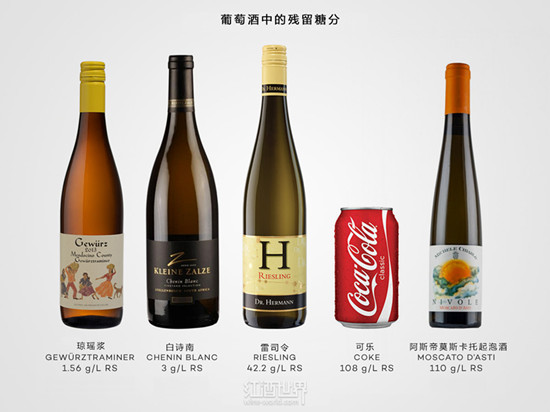
In fact, coke has a sugar content of 108g/L, while the tokai wine in the five baskets (puttonyos) is just 120g/L. (the "basket" is a unit used in the tokai region of Hungary to measure the sugar in wine.) So why does this illusion occur when people drink coke? That's because everyone has a threshold for the perception of taste. Take a glass of lemonade and it may be sour for you, but it's sweet and sour for the other person. Other flavors, such as bitterness and acidity, also affect people's ability to perceive sweetness. The reason people think cola is low in sugar is because the high acid and high sugar in coke is so balanced that it is difficult to detect the sweetness. So, for a riesling or a sweet wine, the balance is the key to measuring its quality. However, winemakers to deal with a good balance between acidity and sweetness is not easy, that is why type sweet wines are not due attention.
Where is the residual sugar?
Residual sugar refers to the amount of sugar remaining in the wine after the fermentation is completed, usually in the form of grams of sugar per litre of wine. The residual sugar in wine is neither corn syrup nor sugar, but the fructose and glucose that the grapes themselves contain. We know that yeast turns sugar into alcohol and carbon dioxide during fermentation. If the fermentation is not complete, the resulting wine will be left with more sugar. In general, the sugars that are not converted into alcohol by yeast are residual sugar.
It is not wise to reject sweet wines
In the general impression, many sweet wines are made by manufacturers to cover the poor quality of the grapes, and the added sugar in the brewing. This is a way of doing something that's very sweet and it's very important to ignore the quality of the wine itself. As a result, for many people, only dry wines are good, and those with high sugar content are often considered inferior. As a result, sweet wines are rejected by the middle class. But these sweet wines, such as Riesling, Gewurztraminer and Muscat, are excellent wines. In addition to these type of sweet wine, there are some very rare quality sweet white wine is very excellent, such as using Bai Wei dyer (Vidal Blanc) and sweet bao xin (Chambourcin) grapes liqueur. In addition, these grapes can also be used to make fine dry wines. Today, winemakers are trying to make dry wines too much, as if only by doing so can produce a powerful drink. In fact, for wine, balance is one of the key factors, measure its quality if a wine residual sugar and tannin, alcohol content, acidity and aroma elements can achieve perfect balance, that no matter how much is the residual sugar, it is a good wine.
Therefore, don't assume that you prefer dry wine to depth, and that you prefer sweet wine to LOW. A sweet wine, as long as its acidity and sweetness are matched, is accompanied by a rich and complex aroma, which is a fine wine. So, next time when someone laugh at you drink sweet wine didn't taste, you can strongly against him: you drink an literature and art, I drink is the real taste of love sweet human instinct, I drink wine I proud